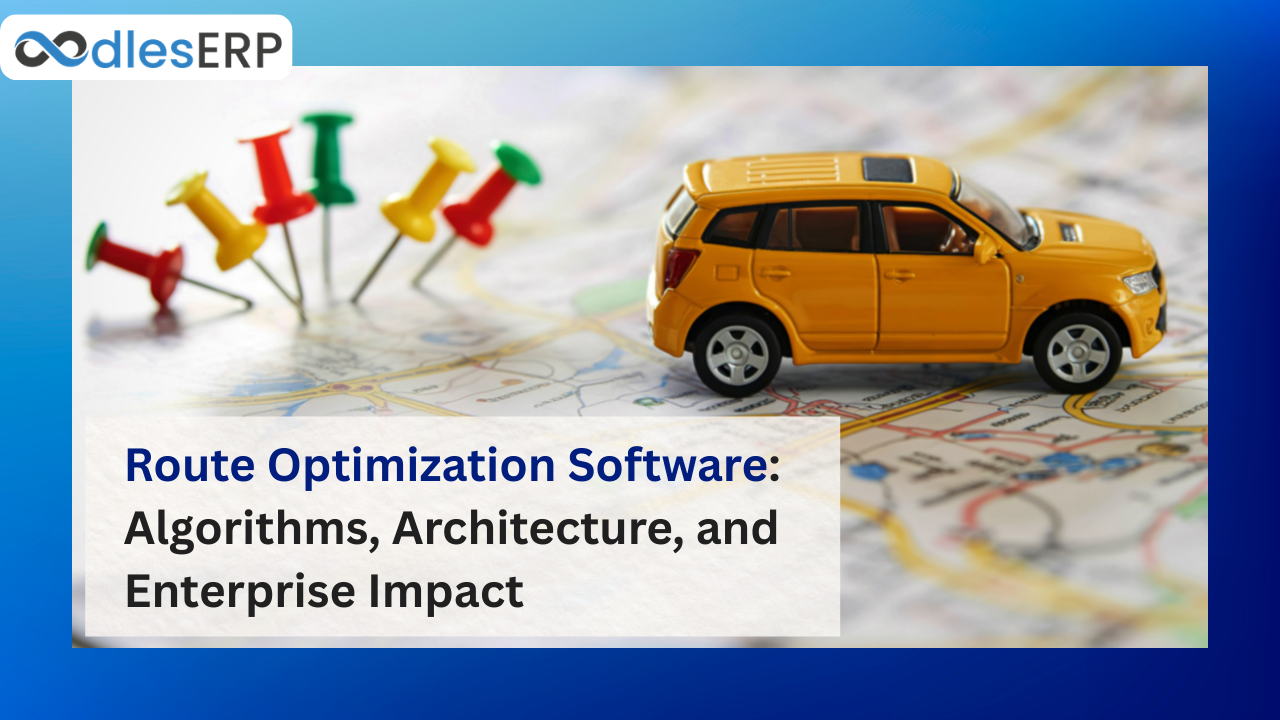
Logistics operations in 2026 are shaped by volatile demand patterns, compressed delivery windows, rising fuel costs, and increasing regulatory pressure around emissions. What was once a back-office planning function has evolved into a real-time operational discipline. Route optimization software now sits at the center of enterprise logistics strategy rather than at its periphery.
This shift is reflected in market adoption trends. The global route optimization software market, valued at approximately USD 7.9 billion in 2025 as per industry estimates, is projected to nearly double by 2030 as enterprises adopt AI-driven, cloud-native optimization to manage scale and complexity. Same-day delivery expectations, carbon-aware routing, and real-time execution visibility are no longer differentiators, they are baseline requirements. For CIOs and operations leaders, routing intelligence has become a structural capability embedded across ERP, telematics, and execution platforms.
Is your current delivery route optimization software capable of responding to real-time disruptions at enterprise scale, or is routing intelligence still confined to static planning cycles and disconnected systems?
What Is Route Optimization Software?
Route optimization software is an enterprise decision system that determines how vehicles, drivers, and service tasks should be sequenced and executed to meet business objectives under real-world constraints. Unlike basic navigation tools, it evaluates thousands to millions of feasible route combinations while accounting for vehicle capacity, delivery time windows, driver regulations, traffic conditions, and service priorities.
Organizations typically evolve through three capability layers:
- Static routing, where routes are planned in advance using fixed assumptions and historical data, with limited responsiveness to operational variability.
- Dynamic routing, which adjusts planned routes based on near-real-time inputs such as traffic congestion, order modifications, or resource availability.
- Real-time re-optimization, where routes continuously recalibrate during execution in response to live events, enabling operational resilience under uncertainty.
Modern platforms rely on decision engines rather than maps, enabling consistent outcomes across scale, volatility, and operational uncertainty.
Algorithms Behind Route Optimization Software
At the core of enterprise-grade route optimization software lies a combination of classical graph algorithms and advanced optimization techniques. While shortest-path methods such as Dijkstra’s and A* remain foundational for geospatial routing, real-world logistics problems extend far beyond simple distance minimization.
Enterprise routing engines address Vehicle Routing Problem variants such as CVRP and VRPTW using:
- Constraint programming to enforce hard operational rules.
- Heuristics and metaheuristics, including tabu search and genetic algorithms, to efficiently explore massive solution spaces.
- Local search optimization to incrementally improve route feasibility and cost.
- Event-driven re-planning, triggered by traffic disruptions, vehicle failures, or priority order insertions.
Increasingly, machine learning models augment these engines by predicting congestion patterns, service durations, and demand volatility. Emerging research using transformers and graph neural networks has demonstrated meaningful efficiency gains when layered on top of traditional solvers, signaling the future direction of enterprise routing innovation.
How effectively can your existing fleet route optimization software model real-world constraints such as driver regulations, service-time variability, and dynamic order insertion without manual overrides or operational workarounds?
Architecture of Modern Route Optimization Platforms
Modern optimization platforms are architected as distributed, cloud-native systems designed for continuous decision-making. Over two-thirds of deployed solutions now operate on cloud infrastructure, enabling elastic scaling and faster innovation cycles.
Key architectural components include:
- API-first integration layers connecting ERP, WMS, TMS, and CRM systems.
- Microservices-based optimization engines that isolate routing logic from data ingestion and orchestration.
- Real-time data pipelines consuming GPS, telematics, traffic, weather, and IoT signals.
- Event-driven orchestration to trigger re-optimization without manual intervention.
This architecture is especially critical for delivery route optimization software, where latency, data freshness, and fault tolerance directly affect customer experience and operational reliability.
Enterprise Use Cases Across Industries
Route optimization delivers value when aligned with industry-specific execution realities:
- Logistics and transportation providers use optimization to balance long-haul efficiency with last-mile responsiveness.
- Retail and e-commerce organizations optimize high-density last-mile routes, which often account for over 40% of total supply chain costs.
- Manufacturing and field services teams coordinate technician schedules, part availability, and service-level commitments.
- Utilities and infrastructure maintenance operations optimize crew dispatch under regulatory and safety constraints.
In these environments, fleet route optimization software increasingly functions as a control tower, synthesizing telematics, real-time traffic, weather, and delivery priorities into executable decisions across large, distributed fleets.
If delivery volumes spike or service windows tighten tomorrow, can your current route optimization services re-optimize routes in-flight across regions and fleets, or would execution teams still rely on manual intervention?
Business Impact of Route Optimization
The business case for optimization is no longer theoretical. Enterprises implementing AI-enabled routing consistently report fuel consumption reductions in the range of 10-20%, driven by lower mileage and reduced idle time. Operational efficiency improvements of 20-30% allow organizations to increase delivery volume without expanding fleet size.
Beyond cost savings, optimization improves SLA adherence, workforce productivity, and asset utilization while reducing vehicle wear and maintenance overhead. Carbon footprint reduction has also become a strategic outcome, positioning route optimization services as both an economic and ESG enabler rather than a narrow logistics tool.
Case Study: Route Optimization Impact Delivered by Oodles ERP
A multi-region logistics operator faced rising fuel costs, frequent route deviations, and inconsistent delivery performance across a mixed fleet. Oodles ERP implemented a cloud-based optimization engine integrated with the client’s ERP and telematics stack, using VRPTW models and event-driven re-optimization.
The solution enabled automated daily planning and real-time route adjustments during execution. Over subsequent quarters, the organization stabilized on-time delivery performance, reduced operational waste, and improved fleet throughput without increasing vehicle count. The engagement demonstrated how optimization, when embedded into core systems, delivers durable enterprise value.
Oodles ERP brings over 15 years of experience designing and implementing enterprise ERP systems, logistics platforms, and optimization engines. The team specializes in API-driven architectures, constraint-based solvers, and large-scale system integration, enabling organizations to operationalize optimization within complex, multi-system environments.
Enterprises evaluating route optimization software can engage Oodles ERP for consultative enablement, aligning algorithms, ERP integration, and real-world constraints into a production-ready optimization capability built for scale, resilience, and sustained operational impact.
How to Choose the Best Route Optimization Software for Your Business
Selecting the best route optimization software requires evaluating architectural and operational fit, not just algorithm claims. Enterprises should assess scalability under peak demand, flexibility in constraint modeling, ERP and API compatibility, and support for real-time optimization.
Vendor experience in complex deployments matters as much as technology. Platforms that allow incremental adoption, planning first, execution next, tend to deliver faster ROI and lower organizational disruption.
Conclusion: Future-Ready Route Optimization for Enterprises
As logistics networks grow more dynamic and data-intensive, route optimization is no longer a tactical efficiency tool, it is a strategic enterprise capability. Organizations that invest in intelligent, real-time routing gain resilience against demand volatility, tighter cost control, improved SLA performance, and measurable sustainability outcomes. When embedded into ERP and operational systems, route optimization services enable continuous decision-making across planning and execution layers. For enterprises preparing for the next phase of digital supply chain maturity, optimization will define how effectively scale, speed, and accountability are achieved.
Oodles ERP partners with enterprises to design and implement optimization solutions grounded in real operational complexity. With deep expertise in ERP integration, algorithm-driven decision engines, and scalable architectures, Oodles ERP helps organizations turn route optimization into a reliable, long-term competitive capability.
Frequently Asked Questions
- What is route optimization software?
Route optimization software is an enterprise decision system that determines the most efficient way to sequence and execute deliveries or service routes while considering constraints such as time windows, vehicle capacity, traffic conditions, and regulatory requirements. - Which algorithm is widely used for route optimization?
There is no single algorithm used universally. Most fleet route optimization software relies on hybrid models combining shortest-path algorithms, constraint solvers, heuristics, and metaheuristics to address real-world Vehicle Routing Problem (VRP) scenarios at scale. - What is the primary purpose of route optimization in enterprise logistics?
The primary purpose of route optimization is to reduce operational costs, improve delivery reliability, maximize fleet utilization, and support sustainability goals by minimizing fuel consumption, idle time, and unnecessary mileage. - What are the main types of routing used in route optimization systems?
Enterprise routing systems typically support static routing, dynamic routing, real-time re-optimization, and predictive routing. Each type reflects increasing levels of data responsiveness and decision automation across planning and execution layers. - How do enterprises choose the best route optimization software?
The best route optimization software is selected based on scalability, flexibility in constraint modeling, ERP and API compatibility, real-time optimization capability, and the vendor’s experience in complex, multi-region enterprise deployments rather than algorithm claims alone.
Author’s Bio
Sumit Rathi is an enterprise logistics and optimization specialist with over 10 years of hands-on experience in route optimization systems, fleet management platforms, and ERP-integrated supply chain operations. He has led and handled complex initiatives spanning algorithm-driven routing engines, real-time optimization architectures, telematics integration, and large-scale logistics transformation programs. His expertise lies in translating operational constraints into scalable optimization models that improve efficiency, reliability, and sustainability across enterprise logistics environments.