Scaling Ride Hailing Services rarely fails because of demand. It fails because operational decisions fragment as volume grows. Platforms struggle with driver oversupply in low-demand zones, volatile ETAs during peak hours, delayed settlements, and inconsistent city launches. As scale increases, Ride Hailing Services stop being a product challenge and become an enterprise systems challenge.
This pressure is intensifying. The global ride-hailing market is projected to approach USD 200 billion in 2025, with long-term forecasts extending beyond USD 400 billion and even higher in some projections. Sustained growth at this level magnifies operational complexity, making integrated control systems a prerequisite rather than an optimization.
1. The Scaling Ceiling Most Ride Hailing Platforms Hit
Early growth often hides structural weaknesses. Manual interventions compensate for system gaps, incentives mask utilization inefficiencies, and finance reconciles outcomes well after decisions are made. Expansion across cities introduces regulatory variance, fleet diversity, and behavioral differences that cannot be managed through isolated tools.
At scale, optimization logic improves local outcomes but destabilizes global performance. Dispatch efficiency increases, yet incentive costs rise. ETAs improve in one zone while degrading in another. Leadership teams inevitably ask: Are we scaling demand, or scaling operational risk? This is the ceiling many Ride Hailing Services encounter before enterprise maturity.
2. ERP as the Control Plane of Ride Hailing Platforms
In large mobility platforms, ERP is not a back-office accounting tool. It functions as the operational control plane, the system of record for trips, drivers, pricing events, incentives, taxes, payouts, and compliance.
More importantly, ERP synchronizes decisions across domains that traditionally operate in silos. When dispatch reprioritizes, financial exposure updates instantly. When pricing shifts, incentive budgets rebalance automatically. When city regulations change, enforcement propagates without rewriting application logic.
A recurring executive question emerges here: Which system owns operational truth when multiple decisions conflict in real time? At scale, the answer must be the ERP backbone.
3. Optimization Is Not One Algorithm, It’s a Capability Stack
Optimization at scale is not a single model or rule set. It is a coordinated capability stack.
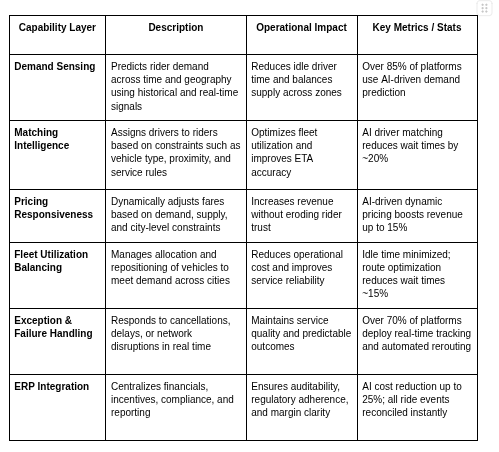
Demand sensing interprets temporal and geographic signals. Matching intelligence evaluates constraints beyond distance. Pricing responsiveness balances elasticity with long-term retention. Fleet utilization manages fairness alongside efficiency. Failure handling absorbs cancellations, no-shows, and network disruptions.
Industry adoption reflects this reality. Over 85% of ride-hailing companies now rely on AI-driven optimization for routing, pricing, or matching. Dynamic pricing alone can deliver double-digit revenue uplift, but only when decisions are grounded in accurate operational and financial state. Without that foundation, optimization amplifies volatility instead of control.
4. Capability Deep Dive: Optimization Engines for Ride Hailing Services
Enterprise-grade optimization engines operate on constraints, not heuristics. Dispatch decisions evaluate driver availability, vehicle class, service commitments, incentive exposure, and regulatory rules before confirming a match.
ETA confidence scoring reflects uncertainty rather than optimistic averages, allowing downstream systems to plan realistically. Real-time reprioritization absorbs traffic shocks, weather events, and sudden demand spikes without destabilizing the network.
Surge containment mechanisms prevent overreaction by aligning pricing actions with budgetary and policy boundaries. Every decision remains explainable and auditable, an operational requirement, not a theoretical ideal, for Ride Hailing Services operating at city and country scale.
Data Flow Blueprint: How Decisions Move Through the Platform
A scalable ride-hailing platform behaves as an event-driven system. Ride requests, cancellations, delays, and completions trigger optimization responses. Commitments update billing, incentives, and compliance states in ERP. Feedback loops continuously refine future decisions.
This architecture underpins modern user expectations. Over 70% of major platforms support real-time tracking, AI-based ETAs, and cashless payments, while more than 85% of bookings occur via mobile apps. In this context, Ride Hailing Software orchestrates interactions, while ERP anchors financial and regulatory truth.
Platform architects often pause to ask: If a regulator audits a pricing or payout decision, can we trace it end-to-end without manual reconstruction? Only integrated systems can answer that confidently.
Where Most Ride Hailing Platforms Lose Money
Margin leakage hides in idle driver time disguised by aggressive incentives, in surge overcorrections that erode rider trust, and in city launches guided by intuition rather than data. Delayed reconciliation prevents timely correction.
Industry data shows that AI-led automation can reduce operational costs by up to 25%, while route optimization and intelligent matching reduce average wait times by 15–20%. These benefits materialize consistently only when optimization integrates directly with financial and resource planning systems.
ERP-linked optimization aligns incentives with utilization, connects pricing actions to budget impact, and restores financial clarity for Ride Hailing Services operating under thin margins.
Real-World Platform Scenario: ERP-Led Ride Hailing Optimization
Consider a multi-city urban mobility platform expanding across Tier-1 and Tier-2 cities. Growth exposed unstable ETAs during peak demand, incentive overspend, and delayed settlements. Dispatch tuning within the Ride Hailing Software layer improved matching locally but increased financial volatility.
The platform introduced ERP as the decision backbone. Ride events updated incentives, billing, and compliance in real time. Optimization engines consumed shared enterprise state instead of operating independently. City-specific rules became configuration-driven rather than hardcoded.
Execution stabilized. Expansion followed repeatable system patterns. Leadership regained confidence in forecasts, compliance, and operational predictability.
About Oodles ERP: Systems Built for Mobility at Scale
Oodles ERP brings over 15 years of enterprise ERP experience supporting transaction-intensive platforms. The team has delivered mobility and logistics systems using API-first, modular architectures designed for operational resilience, regulatory adaptability, and sustained scale across evolving transportation models.
Scaling Ride Hailing Services requires architectural discipline, not feature acceleration. Oodles ERP works with platform leaders to align optimization engines, ERP foundations, and operational workflows into resilient systems that support growth while preserving financial and regulatory control.
Closing Perspective: Building Ride Hailing Platforms That Don’t Break at Scale
By 2026, ride-hailing platforms will be evaluated on operational reliability, financial clarity, and regulatory compliance. Growth alone is no longer sufficient; sustainable scaling requires ERP-driven decision orchestration, integrated optimization engines, and real-time data flows. Platforms that embed these systems achieve predictable outcomes, reduce margin leakage, and maintain trust across drivers, riders, and regulators. Leaders must prioritize systemic maturity over isolated features to future-proof operations in an increasingly complex mobility landscape.
Scaling Ride Hailing Services demands architectural precision. Oodles ERP helps align optimization engines, ERP foundations, and operational workflows, ensuring resilient systems that support growth while maintaining financial and regulatory integrity.
FAQ
- Why do ride-hailing platforms fail to scale efficiently?
Ride-hailing platforms often fail at scale due to fragmented operational decisions, inefficient driver allocation, delayed settlements, and inconsistent city launches. Growth exposes gaps that isolated tools and manual interventions cannot manage effectively across multiple regions. - How does ERP help ride-hailing platforms manage operations?
ERP acts as the operational control plane, centralizing trips, drivers, incentives, billing, and compliance. It synchronizes decisions across silos, ensures auditability, and provides real-time financial and operational truth for scalable, multi-city mobility platforms. - What are the key optimization capabilities for ride-hailing services?
Critical capabilities include demand sensing, matching intelligence, pricing responsiveness, fleet utilization balancing, and exception handling. Together, these AI-driven engines optimize driver assignments, ETAs, incentives, and route efficiency while maintaining service quality and cost control. - How does ERP integration improve financial and operational outcomes?
Integrating ERP with ride-hailing software aligns pricing, incentives, and billing with real-time operational data. This reduces idle driver costs, prevents margin leakage, enforces regulatory compliance, and ensures end-to-end traceability of financial and operational decisions. - Why is real-time data flow important for ride-hailing platforms?
Real-time data flow enables immediate updates of ride events, cancellations, and delays across ERP and optimization engines. This ensures accurate ETAs, dynamic pricing, route adjustments, and compliance adherence while supporting predictable outcomes and operational scalability.